
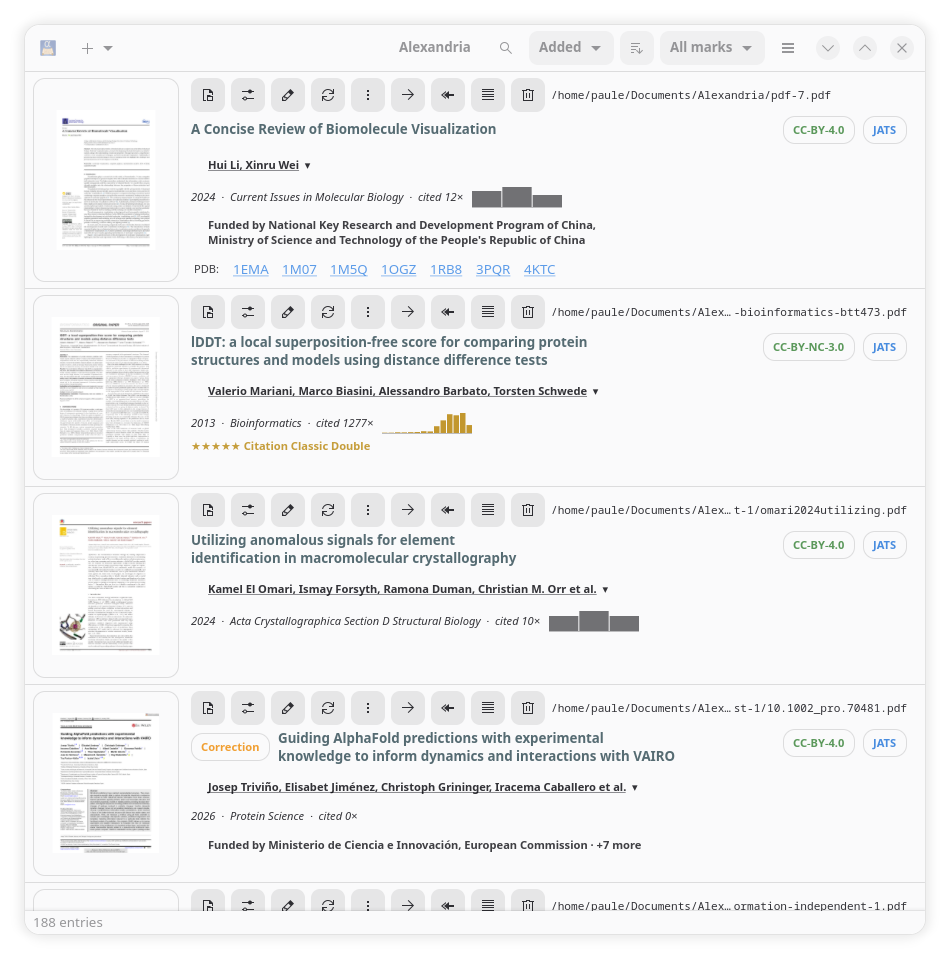
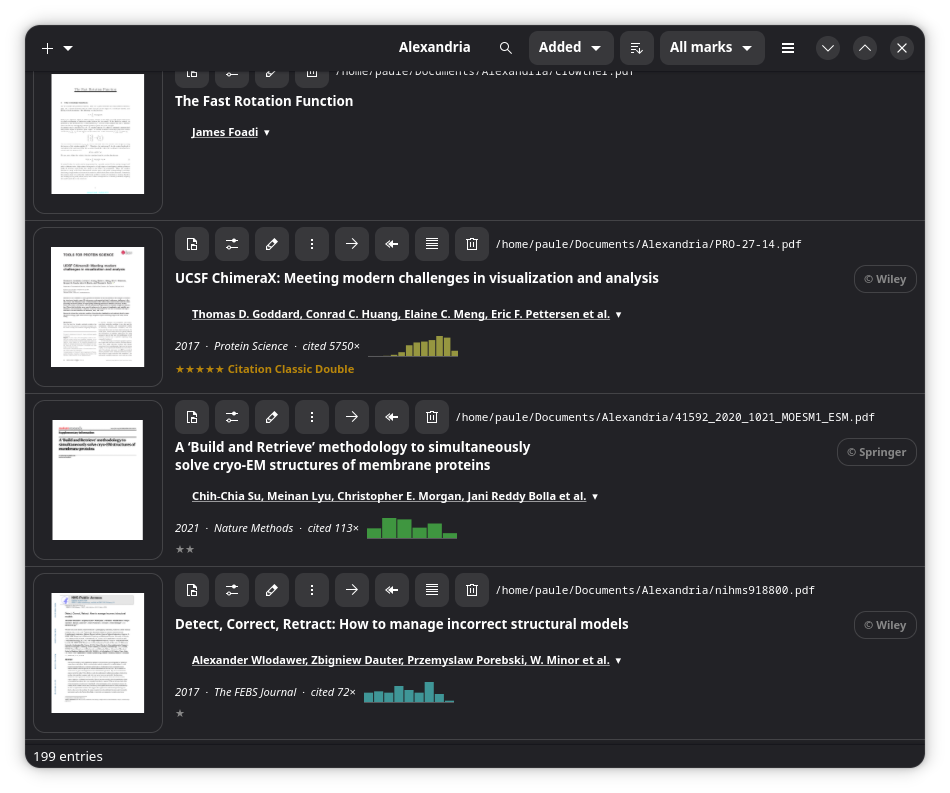
Alexandria is a library for managing scientific papers. Typically starting with a directory of PDFs, it extracts metadata (title, authors, year, DOI, journal) from the page text, CrossRef and OpenAlex, then presents a searchable, filterable card browser. Alexandria tries to make it easy to find and add related papers.
- Full-text search across title, authors, abstract, DOI and journal
- Citation counts and per-year sparklines from OpenAlex
- Built-in PDF viewer with highlight and comment annotations, and click-through citation links that jump to the reference
- A viewer sidebar with the paper's table of contents, page thumbnails and your highlights
- Structured full text (JATS XML) fetched from Europe PMC and stored beside the PDF
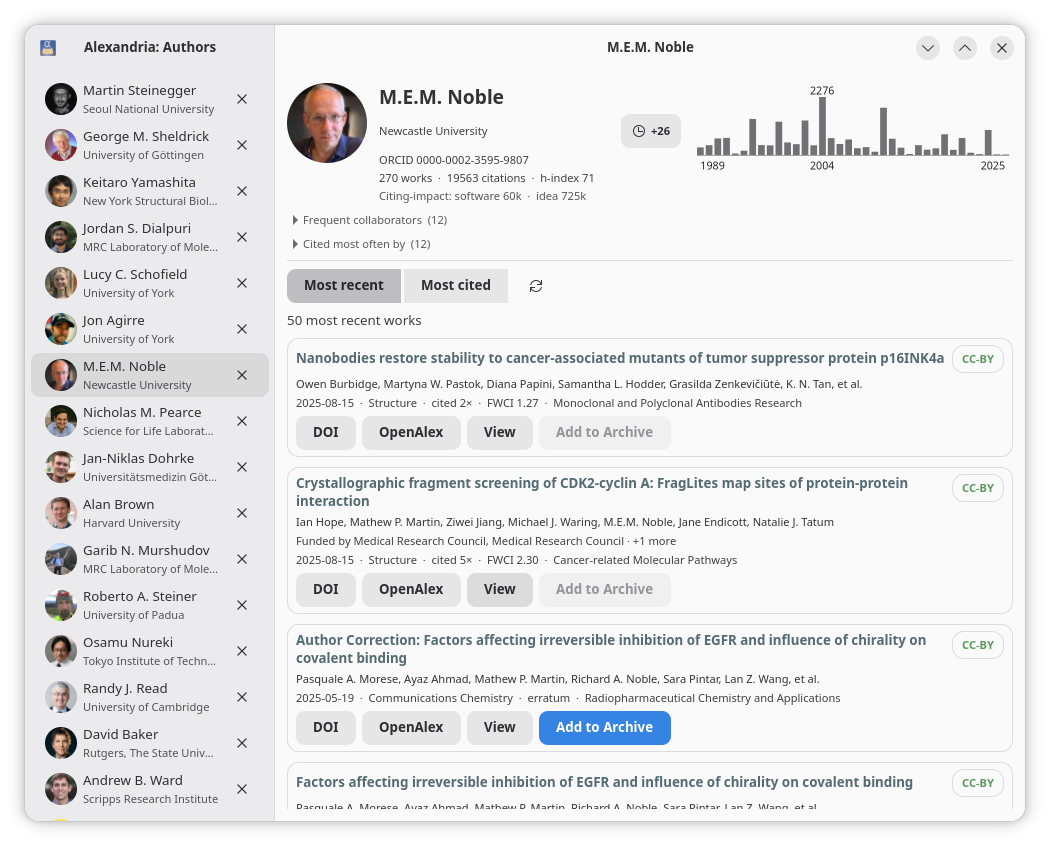
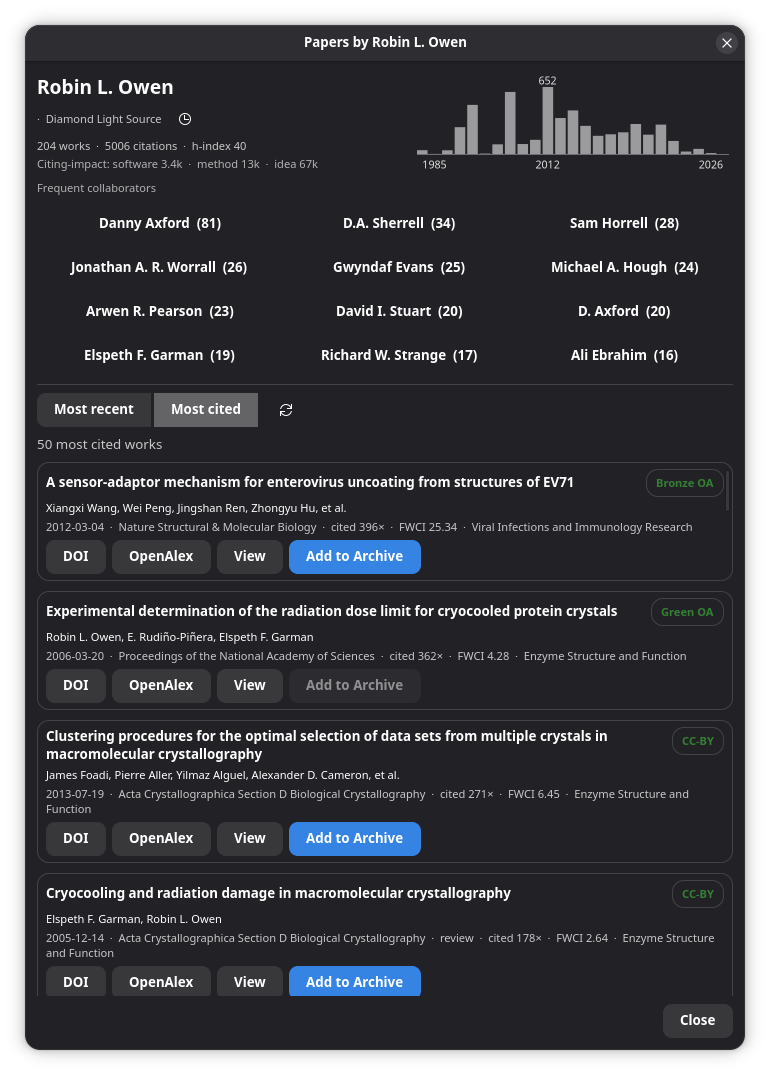
- Authors window: a persistent trail of the authors you follow, with their works, collaborators, funding and affiliation history
- Journal and topic subscriptions, flagging new papers by authors you have looked up before
- BibTeX, RIS and CSL export; BibTeX and DOI import
- Preprint detection (arXiv, bioRxiv, chemRxiv and more)
- Duplicate detection by DOI and file hash, with supporting information recognised as belonging to its parent paper
- An MCP server, so an AI assistant you already use can search and read your library — no model or API key inside the app
- Sidecar JSON metadata lives next to each PDF - so it's easily transportable
Screenshots
Observed history
| App | Change | Version | When ↓ |
|---|---|---|---|
| updated | 0.8.0 | 6 Oct 2026 | |
| new | 0.8.0 | 28 Sept 2026 |
Upstream releases
Release notes supplied by the developer. These dates are not Flathub package publication times.
0.8.04 Oct 2026
Summaries that read as they were written, and an application that can say what it did.
- Paper summaries are rendered as Markdown: headings, nested lists, quotations and code blocks, instead of the asterisks and backticks they used to show
- The OpenAlex API key can be set in Preferences, rather than only by editing a configuration file by hand
- Help → Show Log, with a Copy button for pasting into a bug report — there is no terminal to read when the application is launched from an icon
- The status bar names the file it is talking about, and says when a paper has been added
- Papers whose files have been moved or deleted no longer cost a network lookup on every launch
0.7.126 Sept 2026
A first run that asks where your library should live, looking a paper up from a half-remembered citation, and Retraction Watch in the feed.
- A first run asks where your library should live instead of deciding for you — one click accepts the suggested folder, the other chooses any other
- Discover "By citation": find a paper from its first author, year and journal, or paste a citation and have those three filled in for you
- Follow Retraction Watch, with the article's picture on the card where its feed carries one
- Alexandria knows which folders its Flatpak may open, so a PDF dragged in from out of reach says so rather than reporting "no PDFs found"
- A citing-impact score cut short by a rate limit is marked "(partial)" and recomputed, rather than cached for thirty days as though it were the answer
0.7.020 Sept 2026
Preprints you can follow, finding your way around a long author page, and references that come to you instead of moving you.
- Follow bioRxiv subject collections — each subject keeps its own feed
- Find within an author's works: it highlights rather than filters, so the order of the list is kept
- Clicking a citation shows the reference where you are reading; "Go to reference" still makes the trip
- Cited-by and Related-works rows say whether a paper is open access, and which kind
- pdfx is no longer a dependency — it was archived in 2023 and could hang an import indefinitely
- Clicking a page in the viewer's sidebar took you to the next one
- On some papers every citation was listed twice, and the click took the copy that led nowhere
- An AI summary could show its Markdown raw
- arXiv papers took their landing-page URL as their DOI
0.6.013 Sept 2026
Authors and their photographs are shared across catalogues, funding is tracked, preprints are searchable, and the long waits now say what they are doing.
- One authors database and one author-photo store for every catalogue — the same person is no longer a stranger in your other library
- Funders on papers, and UKRI Gateway to Research grants an author holds as PI or Co-I
- Preprints in Discover, searched at Europe PMC, and preprint PDFs download from bioRxiv and medRxiv
- "Get PDF" and importing both narrate what they are doing instead of sitting on one line for half a minute
- A paper that prints no DOI anywhere can still be identified, from its title
- Copy one paper as BibTeX or RIS from its own card
- Sort the author list by surname, by when you added them, or by when they first published
- A keyboard-shortcuts window, and press-and-hold now opens every context menu a right-click does
- Highlights and their comments are visible in the metadata editor
- Dropping several PDFs at once no longer freezes the window, and a PDF that duplicates a BibTeX entry is attached to it however it arrived
- Citations no longer crash on a page range, and numbered styles put a space after the number